Showing posts with label refugee. Show all posts

Thursday, 19 May 2011

Htam Khur - On the Shan

An abridged version of an interview with the school principal of a Shan IDP camp, February 2010.

What's your name?
My name is Htam Khur, Sai Htam Khur. I'm 35 years old.

Are you Shan?
Yes.

Tell me about the Shan and Burmese.
Shan people, we have our kingdom in the past, and Burmese people they also have their kingdom in the past. And these two, our kings, they are always fighting. If the Burmese win the Shan people need to live under control of the Burmese, and if the Shan people win again the Burmese people need to live under control of the Shan people.
Burma became the colony of British in 1885, and Shan become colony of British in 1887. At that time Shan recognize their people by themself. If the British want to order the Shan to do something they just order to the Shan people directly, not to the Burmese.
When the time that our people need to get freedom from the British the Burmese they want to get the freedom also. General Aung San came to the meeting of the Shan people. If we will take the freedom together we will get the freedom very quickly from the British like that. And so some of the Shan people did not want to get the freedom together with the Burmese people, but some of the Shan leaders think that if we get together we can get the freedom quickly.
So at that time we took the freedom together with the Burmese, but we have agreement. We will organize the country together, during 10 years. After 10 years if the Shan people don't want to be in the union the Burmese, we can separate off by them to be Shan State. But, in 1962 General Nye Win became the dictator and take every power from the people and so until now we are under the Burmese.

Do the Shan still want to be a separate country?
Some of the Shan people want to get the freedom, but most of the people want the rights, the human rights. Rangoon is well developed and Shan state is not. But everything like the teak or the stone, they get it from Shan state or from the other states, but the states are not organized. And also the roads to go to Rangoon, from Daunggyi to Ga Lo the roads are not so good. But from Ga Lo to Rangoon is big road.

Where are you from?
I am from Taunggyi. I live in Taunggyi until 2003. When I finished university I get misunderstanding with my older brother, and I run away from my home to Tachilek. I heard they (Loi Kaw Wan) need a teacher to teach the children. The children are orphans, and people here is like the refugee and they are running away from the SPDC to build the village. So, I join with them and come here. Before I came here I am a shop keeper.

Are you a soldier in the rebel Shan State Army here?
Sometimes we are similar like the soldier, you know? Helping them. But really we are not. I am not a soldier.

Can you go back to inner Burma?
Yes, I can go back, but very dangerous because they (Burmese government officials) will ask me the information about this area. And even I answer them they will not believe on me, and they will put me into the prison. I just organize the school and the orphanage. About the (rebel Shan) army, I don't know many things about the army because I am not a soldier, you know? But the Burmese soldier will not believe on me.

How many students and orphans are here?
298 students. Now we have just 65 orphans.

Where do they come from?
The orphans are coming from near this area. In 1999 the SPDC (Burmese government) forced the people to move from their village, and when they run into the border they are far away from their father and mother and their father and mother don't know where are they. And some of their father and mother getting disease in the forest. And that time, if the people walking in the jungle met with the SPDC soldier, Burmese soldier, without question they shooting to the people walking in the jungle. Like that. So some people die during their running to the border.

Is it better now?
Now is better because not so much are fled from their village. Just in 1996 until 2001, very worse for the Shan people. Because at that time Burmese soldier force the people move from the village to live close to town, and the villager they don't have the money to stay near the town and don't know what kind of job they can do. So they are running to the border.

Tell me about LKW
LKW is an IDP camp. IDP is the internally displaced people. If they stay inside Burma the SPDC will force them to be porter and if they live inside Thailand they don't have the ID card. If they live among the SSA (rebel Shan State Army) the SPDC cannot come and force them to anything. And also the Thai people cannot make the trouble to them also. Yes, is small place.

Is the SPDC here in town?
No, just near our area they have their guard. And they cannot come into the village. But spy, we don't know about the spy. Sometimes spy can be Shan people. And can be Lahu, can be Akha, we don't know. Can be anyone. But even the people who want to come and visit the village if they want to like stay for one night or two night who will receive them to stay in their house, the village committee have to know about their background.

How many people live in LKW?
I heard from the village committee they said over 2,800 live here.

Do you think the SPDC could attack LKW?
Yes. Because it's a resistance group area. If the SPDC want to disappear the SSA, they will attack us.

Do you think it's dangerous here?
Not dangerous. I have lived here for seven years and I have seen no fighting during seven years.

Back in Shan state, in Burma, what does the SPDC do to the Shan?
Now? Now in northern Shan state is very worse for the people. I have a, sometimes I call to my house with my mobile, and sometimes I'm asking about the people who live inside Shan. They said northern Shan state is very worse for the people because now is like ceasefire group and SPDC. SPDC want the ceasefire group to be the border guard, ceasefire group did not want to be the border guard. Ceasefire is not over, just depend on the Burmese. The Burmese want to go around all the ceasefire groups, and they sent their troops every way to the ceasefire group. If the Burmese soldier group is going into the forest they need a porter.

Why do they force civilians to act as porters?
They don't want to carry their things, you know? Because they want to disappear the ceasefire group, and if they are matched against the ceasefire group they want the porters to be their cover. Put the porter in front of them and the ceasefire group cannot shoot them, you know? Ten years ago the same thing, you know? When the Burmese attacked the Muang Tai Army in Hong Mung they bring many Shan people, Shan porter from Shan state. And cover in front of them. And put the porter go first, put their uniforms on the porters and force the porter to go first. The porter, mine, pew! Like that. Is for them, for save their lives they get many porter for them.

Did the MTA know those were porters, not soldiers?
The first they don't know. But when the first attack is finished, when they clean the attacking area they saw the people who die are the Shan people. It's very hard for the MTA to attack the Burmese soldier.

What year did this problem begin between the Burmese government and the Shan?
1947. But at that time most of the Shan people, most of the Shan leaders believe on the Burmese. After the 10-year agreement no Shan people believe on the Burmese.

Are the problems in Shan state worse now, or better, or the same?
The same. You know, during 1962 until 1990, that time the Burmese soldier they are force the people move from the village and burn everything in the village. And next let the people to stay in their village again. And after one and two years force the people out again and burn the village again like that.
The reason why they do like that is to destroy everything of the Shan people, like the history book. Because our culture we'd write our history book and put at the monastery. Who can bring everything? Can't bring everything, so after we move from the village they burn everything. And if we come to stay again we bring back that again and put at the monastery. And for us to move again, we cannot bring most of – you know? And we lose the history book and culture also. And if we mix, like, SPDC get married with the Shan woman, the salary will get higher.

Why is the Burmese government doing this to the Shan? What is the goal?
They want to genocide the Shan people like that. I have heard from the Burmese when I was a university student, “next 10 year the Shan people will be disappeared. No Shan people will speak Shan language,” they said. Some of the Burmese soldier they said like that. When I was a university student I don't know how to speak Shan language.

Not even at home?
Just little. Just get understanding. But when I need to explain something in Shan I can't, just explain in Burmese language.

What language do people speak in Daunggyi?
Mostly is Burmese language. And now, even now my nephew if I call to my house he can't speak Shan. Just Burmese language to me.

------formal interview ends. While walking to the school kitchen Htam Khur recounts how he made a point to learn Shan in university. After graduation he was contracted to teach for three months in a Shan village. After several weeks the local SPDC captain told him to stop the classes and return home. Htam Khur refused. Over a number of days the captain became more enraged at Htam Khur's refusal to leave. The situation came to a head one evening as he was walking home, and the captain stopped him in the street.----- At this point in the story I turned the recorder back on.

'Leave now.'
'No.' I said 'no' again. Yeah he is very angry. He feel very angry and take out a gun, and point to me, you know? And I still said no. We are talking is very loud, very loud. And the villagers heard that and I think 20 or 30 villagers running out from their home, and we two, and they surround all of us. And the Captain cannot do anything. He is very angry and he said to me “now I cannot do you anything, but in the future I'm not sure.” Again, you know?
And I'm coming back with the villager to my rest-house. And the villager said, “hey teacher, this is a problem. You need to go back.”
No, I had the promise with all of you. I need to stay here. Even he is not allow me to stay with you I will stay here for three months. Because of the promise, and teaching is still running, not finished yet.” And the village is very worried for me.
But I'm a little bit lucky, you know? The battalion from the Daunggyi base, they visit the village. This battalion leader we are know each other. And he come and visit me with the Captain. This captain very afraid of me that time, you know? If I say, “this captain he doing to me.”

You told?
No no, I didn't. The Major, he's the leader of the battalion. I didn't tell to the Major anything. And the Captain feel a little bit good.
And the next day he come and visit me. The Captain, “hey hey, sorry, everything that I do on you.” If they have some people afraid they are very kind people, you know?
But the Major heard about us from the villager. And when the major go back to Loi Lem base he ordered to the Loi Lem leader, the Loi Lem leader changing the Captain to the other area.

Loi Tai Leng Clinic


Loi Tai Leng Clinic interview transcript with Head Medic Paw Shar Gay, February 2010

How many medics do you have here?
Here we have two medics, and the other people is me, Ba Tay is finished from Dr. Cynthia's clinic and then the other is finished the Siesta Blue training. Siesta Blue training Community Health Worker. Total staff at the clinic is 22 people.

How many patients do you get here per day?
One day is maybe 20, sometimes 30.

Are they mostly from Loi Tai Leng, or from inside Burma too?
Some people is from outside, some people is from here. But mostly IPD (In-Patient Department) is outside.
Loi Tai Leng's problem is ARI (acute respiratory infection), also skin infection is high. And rainy season is rain all the time, four months no sun. Sometimes is maybe one week or two week sun is come out. You know, our dress we make the fire wood and the fire make dry. The sun cannot make dry. And then UTI (urinary tract infection) is become high.

What do you do to help people prevent it?
Every year we plan to prevent it. Our clinic do like the home visit. One month we will going to section and home by home, give education. And then give information and vitamin A.

Do you see vitamin A deficiency here?
Sometimes we see like one year maybe one case or two case.

Do you always have enough medicine?
Enough medicine? Yeah is enough. Before the medicine did not enough and then we ask more money to buy the medicine. And the Partner did not came in here and also backpack, FBR (Free Burma Rangers) did not come in here. From outside, we take medicine here to outside and go and give the people who live outside Loi Tai Leng, like mobile team, and then our medicine did not enough.
The donor says 'Paw Shar Gay, you say every year medicine did not enough. How about this year, this is enough?' Last year he come back. And then I said, 'yes, before medicine did not enough, but this year enough.'
And then he laughing and said 'why medicine did enough this year?'
'Backpack is coming here, and then FBR is coming here and go outside outside, and same the Partner group is outside and then our medicine we use here not outside.' So here is enough for me.

Are there any backpack medics here?
Backpack medics is four, five people. Yes, sometimes if they come back from inside they coming here. If he going inside maybe two months or one month he will come back here.

Are people's gardens here big enough that their nutrition is good?
Yeah, we see now better than years before. And then we can get vegetables. Big garden (in reference to the sponsored one in the valley) but the vegetables is not enough. Some the shopping go down to Burma part and buy vegetable. Because you know here we can plant in the rainy season. This season no water. We can't plant, we have to buy outside. But in the rainy season is enough. We can buy here and sell here, in the garden. It's like, how do you say, save the money for us. But in the dry season is cannot save the money.

Do you have a computer?
Yeah. One computer is not so good. Internet if we going to the leader's house and check the Internet. But our computer is maybe five years. Is working very very slowly.

Do you see health here looks better now than when you began as a medic 14 years ago?
When I arrived here in 1999, no clinic. In 2000 one clinic. The people, the leader here is building the one clinic, like small like this, this room. We treat the villager, also the military. We treat both. And then clinic is very small, in Section 3.
At that time the people is not know about health. Not health education, they did not know about this so much. They did not know about the family planning. You know in the year 2000 we delivered 120 babies. At that time population is maybe 1,000. And now population is 2,600. More people here but the people know about the education and then they can provide and think. And this year is 42 babies delivered. Very different.
Then you know about the vaccine? Before two year, three year they don't want to receive the vaccine immunization, because the people said if they get the immunization her children is become sick and then is painful, cannot sleeping enough for the night time, because the baby is crying. Very painful, they don't want to come. The health worker is work hard, like go down and give education like this. Because immunization is very very important. But many people they also tell me, 'before we did not receive, we never receive vaccine. But we alive until now. We did not get other disease like you say.'
They ask me and then I answer, 'before is like the before. Before is the disease is not like this. So your baby, how do you say? Like, you is very old, and then you will dead. Your baby is growing and then in the future you will not see. Your baby, maybe your baby can get some anything you did not know about. If you receive the vaccine maybe the vaccine can help like the infection is coming less. Not 100 per cent. Maybe 50 per cent. Explain the parent about the vaccine. And then now, if we looking in the register book the vaccine is become improved. And many children is receive the full course of the vaccine, immunization. For me I think is improved.
And then the last one is education about diarrhoea. We need to boiling the water and then drinking. If you boiling the water, water will be safe for our life. Cannot get the disease easy like the diarrhoea, something like that. Washing the hands for you going to toilet, but if after you finish the toilet after you come back wash your hands before eating.
One man is very old, and then he ask me, because we give toilets, we have the budget for building the toilets. We ask to building the toilets and one man he ask me, 'Sa Mah,' they call me Sa Mah, 'I never believe about this because now my age is 70 and I never boiling the water and drinking the water because if you boiling the water, the water is not sweet. If you go to taking in the river and then drink, is sweet. And then sometimes we did not go in the toilet, we go in the forest. Sometimes we going pass stool in the river,' he said like this.
And then I'm about this question thinking, because I cannot answer yet. I thinking, and then I remember my Sir tell me that if you go in the community you will get many many problems. The people will ask you many questions. And then I remember. I ask that man, 'OK, you say is true. The water you carry from the river is sweet. If you boiling then is not so sweet, right, true. But at that time,' I call him uncle, 'Uncle, at that time how many household at that village?'
And then he answer me 'not so much.'
'And then you see now, many people in this village. And then if the one people going to pass stool at the river, and another people is going to pass, it will put a lot of things in the water. It will be clouding. If only Uncle you going to pass in the river maybe the river will pass stool with the river, but many people not so good.
And the pig, they did not make the pen, they did not have a pen for a pig, they will free for the pig. And then maybe that pig will go pass stool at the river. And then maybe the rabbit, some rabbit is move down to the river. And then this water is sweet. So then uncle is drinking some stool from the river, so become sweet. So that uncle not believe me. Only uncle can pass in the river, but for the other people I think it's not so good if you go down to pass in the river or in the forest. You need to build the toilet. The toilet it will save the stool and then not so smell.

Gong Mong Mung (Hill View Place) LDP camp

Gong Mong Mung is the newest of the SSA's IDP camps. “Mung” is the same as that in “Muang Tai,” the Shan's name for Shan State. The Shan call themselves the Tai. Mung means state, or place. Roughly translated, Gong Mong Mung means “Hill View Place.” It was established in 2007, but not as a result of the September 2007 monks' Saffron Revolution. Most of its 60 families came from a nearby Burmese town that was formerly the headquarters of the Muang Tai Army, until the MTA leader surrendered and the Burmese attacked. Life is still hard for them there because of that.
Unlike the other IDP camps, many of the buildings are adobe. It may be because there is a much larger than usual proportion of Wa and Pa'o mixed in with the Shan. The Commander's place is adobe, with a kitchen, a bedroom and a main room a quarter full with supplies like mosquito nets. He also has wood-shuttered windows, a well made bamboo gazebo, raised flower beds and bamboo fencing. Here, as in Loi Tai Leng, electric cables are strung down the street on sturdy poles.
The SSA commander is a strange looking man. Pale, broad faced, bad haircut and sores on his chin. He wears an expensive looking watch, a ruby ring and a “We Love Shan State” T-shirt.
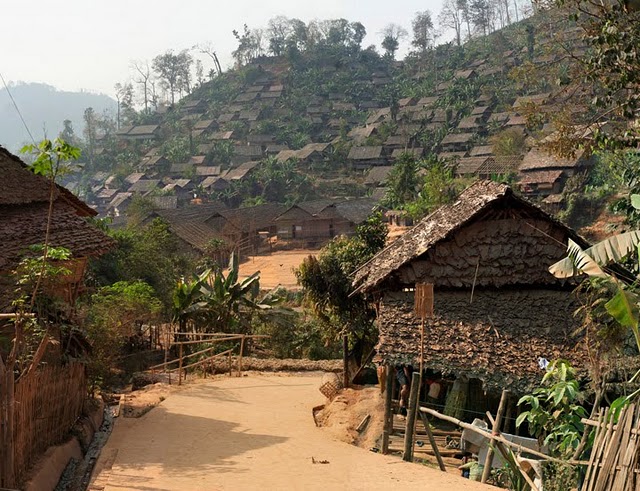
It's a tiny village, with a tiny feel. For now there are only four orphans, only one land mine amputee. Most of the town sits in a bowl shaped valley perhaps half a kilometre across, surrounded by steep forested hills. At Gong Mong Mung's main entrance stands a blue oriental archway. Just a few hundred feet before that is the Thai-Burma border with a Thai military checkpoint, with a red and white striped barrier pole and just one young border guard manning the hut. The kilometre of dirt road before him is met by farmland, then a Chinese village on a lake. It's a beautiful, peaceful setting.
There are three teachers and 50 students in the school, between Grades 1-3. Higher grades will be added as the town grows, more teachers come, and the school adds more classrooms. It is currently quite small – one tiny class building one office building, one dining hut.
As in the refugee camps and other IDP villages many of the students were sent ahead to live with extended family. In Gong Mong Mung they can get better education than inside. The school teaches Thai, English, Burmese, Shan, History, Geography and Math. Later, their families may move here to join them.

Wednesday, 18 May 2011

The Commander of Loi Sam Sip

Another illegal trip into Burma, using what the local connection calls “positive corruption” (whiskey) another dusty refugee village, another SSA commander. 


Since the rest of the party moves like a glacier, and because I wander off without regard, I soon became separated from the others and didn't know where in the village I was or they were. Behind a weak bamboo fence was what was obviously a mini military compound, because it was painted. I saw a truck in there that looked like ours, so, well, they must have driven in and be waiting. There is a compound guard in a little thatched gazebo at the fence, with an MK balanced on his lap. When I walked in, surely the first blonde in months, he looked at me, and I looked at him, and neither of us admitted anything was unusual. There's an army troop truck inside, and a set of flags, so it's a place for some important person. 


After moseying around long enough a woman motioned me in to one of the hot, dark houses, or offices, or whatever. Inside was a man sitting crossed-legged on the raised floor, obviously eating his lunch—rice and dark brown stuff and dark green fluid with black mounds of stuff. He looked at me and I looked at him. I said hello. He said something authoritative to the women, who showed me to sit down, and scurried off. A walkie-talkie buzzed on the table in a corner of the room, which was heavily decorated with maps of Burma and pictures of military processions. I sat down across from him and we looked at each other. 


His English was laboured, but he was the only one around who could speak it, and the only man about the place. “What country you from?” “Canada.” “Hm. Canada.” A woman came with a bowl of rice, for me. “Nam nam nam!” he said, and she returned with a glass of water. I spooned the broth from the black stuff onto my rice, which made whoever this guy was laugh. It was strange him being here, since word was all the village men had left to work in the fields. “Yum, good. Thank you.” “You are medicine?” “Medic? No.” “No medic?” He looked at me sideways and I hesitated and looked at him sideways. “I'm...a...journalist. Newspaper.” He raised his eyebrows and frowned and looked at my camera. Then he laughed but not a happy laugh, rather a slow laugh. “News. How you come?” “Someone brought.” “Who brought?” We stared at each other. I shook my head. “I don't know who.” “Sai Sam?” “No. I don't know. You medic?” “Ha ha!” “You're a soldier?” “Hm, yes soldier.” The walkie-talkie buzzed intermittently, and I accidentally looked at it every time it did. The woman brought another dish, of green and red crusty stuff, and another bowl of rice. “For you, I can't eat more,” I told him, but he shook his head and waved me to load up. “OK, you're big, I'm small.” “Ha ha!” “I take half, you take half,” and I did. “You SSA soldier?” “SSA...You come Dr. Myron?” “Dr. Myron?” then I breathed relief. If he knew of Myron then whoever he was it was probably OK. I told him yes yes, with Dr. Myron. He asked how many of us came, whether we were staying the night, how I liked his food. I ate as heartily as I could to ease the long pauses between our exchanges. He told me Myron was coming to the compound, and I knew I just had to bide my time and so on. Of course, the reason this man was still in town when most others had left to farm, was because he's the regional rebel commander। He's running the place। Jeez, I'm glad he liked me, because eating with him even before I knew who I was with was a bit of a pickle.By the way, he gave me an SSA 2009 calendar.

Bay Da

We arrived in Loi Kaw Wan in the afternoon. Once we came through town to the medic compound, we stood and looked around at things. Suddenly a tall young man running at full tilt leapt onto Dr. Semkuley and hugged him with his arms and legs. That's the most emotional reunion I've ever seen between two men. The man was Bay Da, whom everyone knows has the biggest smile since Eddie Murphy, and much nicer than Murphy's. Especially since the corners of Bay Da's mouth curve up, even when he stops smiling, which he eventually did. He smiled so much those first few days anyone would think he was the happiest man in the borderlands. Of course, his smile fell into disrepair over the next two weeks. It began with slow fractures, changing from joy at having Myron back, to worry, nervous smiling. Beaten dog smiling. Shorter smiles, frowning in between, right in front of us. It took two weeks for Bay Da to stop being formally gracious, open up, and say enough for me. Two weeks to say something to me that could make me cry. When the woman watching her mother die of AIDS in the clinic down the road only made me angry. Bay Da climbed down from the frame he and the others spent all day building to hold these mega big solar panels, so the clinic will finally have night light. We sat on the grass together and he took off his Chinese army boots, inside which his feet had stewed all day without socks. Man what a stink! Like grade C ham left under the deck for a week. I moved to sit up wind and we joked about the smell. He said I should write about how people in Loi Kaw Wan are too poor for soap so donors would send some for his feet. Then we headed off to bring the tools someplace for safe keeping.


“Sometimes when we walked in the forest for four or five...or seven days, very difficult to get clean. No soap and got very dirty.” “You mean you were in the forest for that long?” “Yes” “What were you doing in the forest for seven days?” “Hiding, from Burmese soldiers.” “Oh. You were one of those people.” “Yes.” “What would happen if they caught you?” “They want to make us porters. Porters carry their weapons and food, and big bombs. A big bomb... They burned my father.” My skin crawled. “They took cigarettes, pressed on his face. You know when cigarettes burn, and the end is red? They burned on his face, here,” he traced his finger along his cheeks, “here.” “They tortured.” “Yes, tortured. I was seven...or six. I never forget that in all my life.” Earlier we had also joked about how he would like to be president. The things he would do, notably enact litter laws. Bay Da is an environmentalist, dislikes litter, and takes the decimation of the local teak forests by the SPDC personally. As he should, the SPDC are raping his people in order to rape his land. Anyway, his president talk ends with a smile and he says “in my next life.” “I want to have some coffee.” “I want my freedom.” “And what will you do with your freedom?” “I will travel, and present about Burma's politics and the environment.”


I didn't expect him to have an answer so ready. After we put the tools away, and after he told me about his father's torture and I tried to keep my head tilted up so tears wouldn't fall out of my eyes and perhaps he was doing the same thing, he told me more. “I will tell you my real dream. This is real, what I wish. I want to go to a small village and teach English. Have maybe 50? students. I teach English and improve my English. At my home town we have waterfall,” he showed with his hands, “a beautiful waterfall. And land is flat and soil is very...good.” “It's no good here?” “No. Very hilly, and difficult to bring water.” The Shan aren't a mountain people. They are traditional farmers who are used to rich plains where they can grow just about anything. This place is Akha land. The Akha like the rugged land, but they had to move aside here to make room for the Shan refugees. 


“I want to have a house, and around the house, trees, because I like the environment. I would have trees. That is my real dream.” “Do you want this in Shan, or Thailand?” “Shan. If I can, I don't like in Thailand.” 


The whole time, his nervous smile would flicker by. It's surprising how a face constructed to fall so naturally into a wide grin can drop into such exhausted despair. He'd mentioned even on the first day that he doesn't think about worrying things because it would just make him depressed. But I knew when he said that, even though I didn't know him, that he must think about those things all the time.

Uncle Sam

“Don't take my picture. Don't say where I take you. Don't call me my name, call me 'Uncle Sam,' I have enough problems before with foreigners.” Uncle Sam began his life when he was born in Rangoon in 1951. That was before the junta. His mother was a midwife and his father was a health assistant for the government. Even though they were Shan, they had little to fear from the government because of their jobs, and because things weren't so bad then. 


When he finished high school and had to choose a career, Uncle Sam chose jade trading. Moving gem stones out of Burma was a popular business. His dad gave him some start-up funds, which Sam quickly ran through. The trade wasn't as easy as he thought, so rather than face his father with the bad news, Sam went to work construction in Bangkok for three years. His father wasn't an idiot. He entreated Sam repeatedly to come home and try something else.


“You don't have a head for business Sam. My friend will set you up with a job in the hospital mixing drugs.” Sam took the job. Although he wasn't impressed with the pay he found he liked being in Health. Eventually he became a health administrator for the government as his father had been. As such he was assigned to government convoys sent to the Shan countryside, forcing development projects along the way. Much of what employees like himself told the Shan about the projects and the benefits was just propaganda. They never got much. Shan nationalism was growing then. The people weren't happy, not with the government, not with the union, not with the starvation. Kun Se's rebel Maung Tai army was getting stronger, really at its peak back then. They had real weaponry, real training, tens of thousands of volunteers. And of course, such a charismatic leader. Uncle Sam began to help them secretly. As a government employee, the son of a government employee, from Rangoon, he was above suspicion. He wasn't counted among the Shan, even while he stole medicine from the government and gave it away. 


Things were going fine and he wasn't particularly worried about being found out, until Kun Se surrendered to the Burmese in 1996 and went into house arrest in Rangoon. The Maung Tai army broke into pieces, and in the crumbling Uncle Sam was ratted out. “Betrayed me!” he says. He fled to Thailand. 


When he arrived there he found a reunion of rebels. A little disoriented, he served briefly in what was left of the rebel army. By 1997 he knew soldiering wasn't for him any more than gem trading. He learned of the medic training centre in Thailand, further south along the border. The Shan sent him there, where he trained for two years to become something of a rough and ready doctor. He was good at that. And ambitious with it. Before too long he brought his skills to camps of displaced Shan scattered along the northern Thai-Burma border, where the Shan were pushed by a furious Burmese army. Those refugees are still there. Uncle Sam still sends them medicine. 


Today he lives permanently in Thailand, fat and loquacious. Canadians bought him a migrant worker ID, and as long as he has that he can stay. He is happy in his young career. He takes Shan teenagers and makes field medics of them. He butts heads with rebel commanders who stew along the border in new villages of displaced ethnic minorities. Butts heads with well-meaning foreign doctors who come to help him train. Can't ever go back. He betrayed the Burmese government, and then was betrayed himself, so he cannot go back and keep his life.

Mae La Oo Refugee Camp

With 16,000 registered residents, Mae La Oo is one of Thailand's mid-sized camps for Burmese refugees. It's estimated there are thousands more people than this living here, but the UNHCR provides rations for 16,000, so that's how many are permitted to register to live here.

The Thai policy is to let no foreigners into the camp, but as with everything else, as Hlah Tay says, they “have an understanding” (bribe) about letting them in anyway. “Everything here is under the table. Like we are travelling today, it is under the table. You saw the driver give the guard the money... Everything is an understanding under the table...it's very difficult for anybody to get out.”

It's expensive to get in too, or at least it was when the ABSDF brought us in. A "pass" comes to 1,500 Baht per person, about $50, plus 2,500 Baht ($85'ish) to hire a driver, each way. Hlah Tay estimates "no more than 100" foreigners visit the camp every year. Most are NGO workers, some are undocumented guests like us.

NGOs and the UN pays for everything in the camp, including the salaries of some of the border police. The Thai government pays nothing. The country does benefit financially because it's from Thailand that supplies are bought and drivers are hired. Even lumber and bamboo is bought in Thailand and trucked in, since it is illegal for refugees to cut teak or bamboo, and they could be arrested if caught doing so.
Cutting teak will bring a 6–7 year jail sentence. Trucked-in bamboo costs 25 baht per pole, wood is 200 baht per pole, with transportation charged on top of that. There is almost no way to make money in camp, but there are somehow many ways to spend it.

Even if there were as many residents as food rations, it's unlikely there would be enough to go around. The camp is divided into more than a dozen sections. Each section has a committee in charge of distributing food. However, rations can be skimmed. On our trip out, our group sat on top of bags of rice the truck driver bought in camp, saying it was a lot cheaper for him to buy food there, presumably from the section storage house,  than in town.

Hlah Tay believes there are 8 refugee camps in the Karen-Karenni region. There are some more in the south, and one registered Shan camp; about a dozen official camps in total. After that are IDP communities, unregistered refugee communities, legal and illegal migrants, bringing the number of Burmese refugees in Thailand or near the border to around 2 million, though no one is sure.

The camp has a very cramped, ramshackle feel. Refugees can't leave this camp for Thailand because it is very remote, and the road has a number of Thai border guard check points along the way. There is no need for a fence. There's no sign anywhere of a UN presence, for example row or prefab housing, signs, offices. Word is the Thai government works hard to keep the UN out, though the UNHCR is the umbrella organization for Mae La Oo.

Motor bikes are illegal here, again permitted “under the table,” so of course they're all over the place. I ask how I'm going to leave the camp, and Hlah Tay explains: “Yes, we will make arrangements. You can go by motorbike.” I ask if I can't hitch a ride with an out-going transport truck. “Oh no, because driver would not dare.” I do leave by motor bike the next day, with an ABSDF driver. 

The inhabitants of Mae La Oon are a mixed bag compared to Shan land. There are a few Shan here, like  the man building a new house who does push-ups every morning, and practices his English in the hopes it will help his resettlement application. He has been in camp for six months, and wants to go to the US.
Others range from curly-haired East Indian looking people, to square-faced Mongolians, to round-faced, pale people with full red lips. 

It's crowded. Dogs, poultry, pigs and people are close together in small, often randomly arranged bamboo structures. Theirs is an accentuated appearance of poverty as they are forbidden from creating permanent concrete structures. There is a narrow paved road through the centre of camp, some of the rest of it has gravel, most is packed dirt. Even the school is a bamboo platform on top of muddy sandbags and dangerously eroded packed earth.

Mae Sot


The streets of Mae Sot are always hot. I can't tell if it's humid or not. The heat makes me sweat so fast that I'm always sticky even if the air's not.

Unlike in the north, cultural differences, ethnic differences are pronounced here. There are different ethnic groups in Shan, but the differences are hard for an outsider to notice unless they're in traditional dress. Mae Sot is a town of migrants, refugees, aid workers, tourists excited about a day trip into Burma on the other side of the bridge. 


The Burmese don't try to hide. Some are pale, round faced women, their cheeks painted yellow with home made sunscreen. The men wear their longgyi – the Burmese name for sarong. Muslim Burmese are here too. They look like Malay, East Indian, something I can't place. They wear embroidered fezzes and the women wear the kind of hijab that makes a circle of their face. 

Beekeeping with the Karen at the Global Neighbours Farm

The Karen people are packed up along the border, fill huge refugee camps here, sneak in to work illegally throughout Thailand, wear traditional brass rings meant to elongate their necks in the hopes of attracting tourist money, even though the practice had nearly died out before the tourists came.

Their language is quite different from Thai, making it harder for them to blend in and disappear than for the Shan, whose language is closely related to Thai. The Karen are as persecuted in Burma as the Shan (and Mon, Arakan, Rohingya, Chin, Wa...). Like the other ethnic groups they have a rebel army fighting vicious ambush warfare against the Burmese military in jungle.

Here in Mae Sot Karen trickle in from the Burmese countryside, cross the Friendship Bridge from Myawaddy town, take boats across the muddy river, and escape the Mae La refugee camp not far from here. They come for work and help.

A young NGO from Saskatchewan called Global Neighbors has a farm on the edge of town meant to train Karen migrants and make money to pour back into Mae La or other refugee aid projects.

The Karen staff's temporary living quarters on the farm is a typical raised bamboo longhouse, thatched with layers of dried leaves. Chester explains a slideshow about beekeeping to a group crowded around his computer. Through Henry Tha Won Phirachenchei's interpreting, the group ask if the bees sting, why do beekeepers blow smoke into the hive, how to extract honey. They laugh at pictures of a beekeeper clipping the queen bee's wings, saying they don't think they could be that careful. Outside the hut geckos, chickens and dogs compete for sound space.


The Karen are dark, with angular faces accentuated by strong jaws and high cheek bones. Their teeth are filed straight and often stained from chewing betelnut.

"So," Henry asks, "we need to plant many many flowers?...So, I will plant around the stream here, flower flower flower... Now I will try to call someone. Behind the house have a very big hive." Henry is all action. Already he's on his cellphone, still watching the bee video from the corner of his eye.

The crowd grows in the hut as young men come in for lunch. When Henry's finished on the phone they start asking questions again: How do you catch a swarm? Do bees sleep in the day? Should they look for the big bees that live in the trees, or the little ones in the ground? How big should they make the hive boxes?

The air becomes thick with the smell of betelnut once men fill the hut. They wear longgyis or faded jeans.

Interview with Global Neighbours Founder David Heppner, February 2010

Tell me about Global Neighbors. What is it, how did it get going? 
Heather (Heppner's wife) and I travelled to Thailand in 2004 and we were introduced to the situation on the borderline. We actually visited a small school, Saw Thoo Lei, I don't know if you've visited that school or not. We decided we couldn't change the entire world, obviously, but we did think that we could make a difference in this one place. So Heather and I decided to help the one small school. And we came back to Prince Albert and started talking to business people in the city here and people rallied behind us and they joined in and we bought some land and built a school for Hsa Thoo Lei and then after that we bought the land where the school was built and we built a dormitory for 200 kids right next to the school. And after that we built a day-care for abut 80 kids and so it just kind of kept on going. We just finished our last dormitory, as far as the education goes we built a dorm for 200 kids. The old dormitory is going to be used for future training and offices for the Burmese migrant workers association.
So that's basically how we got going, and from that point we branched out into two agricultural projects. 
We bought 79 Rai (30 acres) in Krep Lo, which is just outside of Mae Sot. We've had it for one year, and that's the farm we bought. We have title to it. And there's another agriculture project we're working on as well which is the school of 360 kids in the area and they are and were in extreme need of funding. So instead of funding the school we set up an agricultural project there as well. We bought about 40 Rai in that area, which is probably around 20 acres or so (approximately 16 acres), and we built a hog barn for them there and set up an irrigation system. And hopefully we'll help them into self sufficiency within the next couple years.

Who introduced you here?
What happened is, the reason Heather and myself went is my daughter and our son-in-law were hired to set up a program in Thailand, an experiential program with a university. My son-in-law couldn't go so the director of the program and my daughter went and they asked us to join them. And while auditing and eating with a member of the Chiang Mai University and the International Justice Mission - the International Justice Mission works with getting kids out of the sex trade, and so at the end of the meeting, which was actually quite graphic, they said there's another issue that's more pressing and that's the migrant situation on the borderland. After hearing that said we need to basically check it out. We rented a van and we picked up a Karen translator in Mae Sariang and then we drove down to Mae Sot. He showed us Mae La refugee camp, and then we also went to Mae Sot overnight and just before we left in the morning we spent about 15 minutes at the school. And so that's basically how we got to Mae Sot.


So you were hooked on the Karen?
Yes I was. We were very much engaged. After, we wanted to help them. There were some very very good people with a very difficult past and a rather bleak future from the way it looks right now. But hopefully things will change in Burma so they can go back to their homeland.


Tell me about your plans for the farm. Henry (farm manager Henry Tha Won Phirachenchie) took us out there the other day, now I'd like to hear about it from you.
Well first of all I'd just like to say that Henry is a gem of a man. We're just so privileged to work with him. He is a positive, energetic guy, who's just very happy to be helping his people.


Did Henry give you the story of what he did before? Yes, he said he was a caretaker with his family for a bunch of orphans in Mae La, but not too too much.
Well, basically what happened is he started a school (in Mae La refugee camp) there's about 200 odd kids there and he started the school, and he funded the school entirely on his own. He worked for Princess Cruise Lines. And he has had Hep B since birth, lots of people in Mae La camp have it. They did testing after about four or so, four or five years of him being with Princess Cruise Lines, and they tested for hep B and he had Hep B and therefore he could no longer work. And so here he was left with the dormitory and the school and no funding. And this is where we kind of intersected our lives. I was very impressed with him when he was translating for us and I asked him if he would like to be the manager of our farm. And he was very very excited about that and he still is to this day. So that's kind of how we bumped into Henry.


So what we've done now is it's one year of operations, it's been a fairly intense year because it's a large farm, by Thai standards, and everything is basically done by hand. We do have a tractor there and we do have some automated equipment like the rice planter and we also plant beans with like the big rototiller, the iron ox I call it. But we've got plans to grow fish. We've got probably around 30,000 and 40,000 fish. We had bought just 10,000 catfish for the four little ponds you saw there. And the bigger pond is supposed to have 30,000 fish in it, I'm not sure how many are there actually.
We're learning as we go. There's, I think there's some serpent heads in there that et fish and so we, what we're planning on doing is just leave them as they are, pull them out and then we'll drain the pond and clean the bottom out and make sure there's no predators in there. So we can be more effective in that particular pond.


We've got a sort of makeshift irrigation system going right now. Obviously for the dry season we need to irrigate, and we'd like to set up a permanent irrigation system. Now they're just kind of hauling pipes around here and there and keeping things wet. When there's excess water they'll just flood the rice paddies and then they irrigate that way as well.


So our plans for the farm, we're building a workshop, storage area and a small office in the front of our property. They're putting footings down right now. So we're vying to do a workshop where we're hoping to train students in some vocational training like wood working and welding. Also, when we bring our teams over we'd like to do the construction of desks onsite as well. And we'll be working with an organization called Youth Connect, they're in Mae Sot. and they work with kids once they've got out of school. And some of those that don't succeed in school, like if there's a 17 or 18-year-old fellow and he's in grade 5 for example and he's not going to make it we'll try and get him trained up with welding or some of the other trades, electrical 
or whatever, And so they can use our facility, and then we're going to store our equipment in the warehouse as well, and then we're hoping to, there's an organization called Compassion International, and they have excess materials in a warehouse in Victoria. Like when manufacturers have overproduction they get materials from them. So we can have the materials for free if we pay for shipping. And so we'd like to have a distribution centre there to be used for distribution out of the building as well. So those are our immediate plans. We'd like to have the farm as a profitable entity and we can use all of our profits in the borderline area.

What made you decide on starting a farm out here? Was it that you wanted to use the food, or to use the money out here and train people up?
Well Heather and myself have been on the grain farm out here for 30 some odd years, so we're familiar with farming. We also thought it would be something that would keep on giving if we, once we were gone, or not here anymore in a few years time. The farm will still be operating and still be generating income for people in need over there. It's just a sustainable kind of a thing where we can either provide food or we can provide funds for projects. And I think we're probably going to be doing both. We've planted fruit trees, and hopefully in a couple years we'll be producing a fairly large quantity of fruit that we can either sell or we can bring to the kids in the camp. There's no problem getting rid of food.

How long did it take to raise funds? This sounds like a big project for a young NGO.
We are a fairly young NGO, we registered in 2005. We've been very fortunate with some of the people who travel with us. Some of the business people really like what we're doing and they've joined in with us. So we've got large number of supporters in Saskatchewan, mostly. We've got a few in Alberta, but mostly in Saskatchewan. And some of the supporters will take on entire projects. The hog barn was built by a retired fellow from Roster, actually he lives in Hague, his business was in Roster, and he raised all of the funds to build hog barn. And so he was out there supervising the job with the local people, and he funded the netire barn. So we've had some very very good support. A lady from north of PiĆ©, her husband farmed for most of his life, and he passed away a couple years ago and on his death bed he told his wife that she needed to share some of her funds with people that needed help. Their family donated a tractor and rototiller. It's just been that kind of thing where people have joined in and helped out.
How much does it all cost? 
The equipment, that's the tractor, it's a 70 horse power with a blade on it, we've got a rototiller, we've got a disc, and we've got something else, a corn planter, and I think that was around $37,000 for that. The land cost us around $200,000. The warehouse will probably be around $30,000, that they're building now. And Propera was around $30,000. So yeah, there's been a lot of contributions.
(totals nearly $300,000)
And this is dollars, not baht?
No, we're talking dollars here... Part of the reason for our success is that all of our funds that we raise go right over to Thailand. We have less than one per cent is what I would say is going into accounting fees and stationery and that sort of stuff. Up to this point we have raised - 100 per cent of our money is going over to Thailand. I'm not certain we can continue doing that, but it will be very close to 100, it will be in the high 90s. For some organizations, and I don't criticize them because you do need to have full time staff when you hit a certain size, but we're small enough that we don't have any paid staff. Everyone pays for their own way, and all of the money that we raise goes to Thailand.


Do you or your wife have any development experience, or did you just take the plunge?
No we didn't. Actually we didn't anticipate it growing this quickly. But we've never done this kind of work before. So it's not just my wife and myself. At this point we've got a board of directors who've done a good amount of work when it comes to fundraising, so it's not just my wife and myself.


How many people do you expect to employ at the farm, and who are they going to be?
They're all going to be local workers. The amount of workers we employ varies. Like, during the harvest time everything they do is by hand, there's no swathers. So everything, all the beans are cut by hand. We have about 25 workers that work on the farm during harvest season. Then it cuts down, I think he's probably got about five or so. He's got roughly five working now, they're just putting on fertilizer and there's something they spray on the soybeans to get them to set nitrogen. They do that just by hand, by hand sprayers. So everything is done pretty much by hand.


Have you had any successes so far you'd like to tell me about?
Well, our rice harvest was quite successful. We're growing jasmine rice, that's for export. Henry is the one who decides what we're going to plant and he's very keen on trying to maximize our return. So he went for an export quality rice. We don't have it hulled yet, we're buying a rice huller within the next month or so. There's 280 bags and they weigh about 200 pounds each. They're really huge bags and they're all full of rice. We don't really know what we're going to get until it's been hulled. It's like an oat or a barley seed, it needs to be hulled before you can see the rice. So we're going to hull it and bag it and sell it. And the price has been fairly good, I think we would have had at least an average crop of rice.

The beans were, the green beans were fairly good. We had some issues with, there were some annual grasses or perrennial grasses growing in the field and they took away some of the yield. We've since found out that if you put Roundup on it it kills that quite significantly. So we've put Roundup on the piece that was grassy and it's quite nice and clean right now. So next year I think we're going to anticipate a bit better yield with the green beans, but the prices were really high this year.

Do you find that you're learning a lot about the difference in farming out here in the tropics and that in Saskatchewan?
Yeah there's a huge difference, there's no rest over there. In Saskatchewan when you finish the harvest you do your fall work, you basically put your equipment away and you wait for spring. You anticipate and you prepare for spring and do your planning. But over there you're already planning and doing your next crop before your crop is harvested, and as soon as you've got your crop off your working on getting another crop planted. So there is quite a difference there. Also with irrigation it's something that I'm not familiar with but and I'm not familiar with growing rice and some of the other crops there. But I do have some experience with some of it.


What is your background?
I'm also in real estate. We have some real estate properties that we still own. And I've done some land development. So we're self sufficient at this point, we're not needing to take income from donors for doing this kind of work, so we're self sufficient that way.


What are some of the problems with the project? Henry said when locals found out the farm was a foreigners' project they raised their prices, is that true?
Yeah the land prices all around us have quadrupled since we bought, so if you want to buy another piece of land you have to pay four times as much. And we were wanting to buy a small piece of land to put the warehouse and office on there, but we've since decided that the prices are too high now, so we're just going to put the warehouse on our own land. We do have a little bit of problems with the authorities, but not a lot. We're trying to work in conjunction with the Thai people, so we do have Thai people that work alongside us as well. It's not just foreigners and people from the migrant community. We do have people working with us and we're trying to work in conjunction with the head villager and – Apataw is his name and it's kind of like the district manager. So they're quite aware of what we're doing and we're trying to work in conjunction with them.

What did you do here during your February visit?
Well we had to make some decisions. We did the final design plans on the building at the rear of the property. Henry's going to live at the back, he's going to have residence there. We're going to have workers' accommodations, we want to be able to have four rooms for workers. We're going to have two rooms for kids from Mae La refugee camp. There's 12 kids who'd like to go to higher education next year so we're going to put them and a dining room and staff rooms there in the back.


Do you want to become firmly established as a Mae Sot NGO, or are you willing to help out in other borderline areas?
We would consider other locations. Right now we're quite fully engaged in this project. We're planning to do the sow operation at the Mae Tao farm, we'll be starting the sow barn within the next month. We'll be building the sow barn in Mae Sot and then the hog, the finishing barns in Saew Ki and Propera. Then taking the weanlings from the other barn and then we're hoping that they'll learn how to butcher hogs and then we don't have to sell 
them into the market, we'll actually butcher them. We'll butcher them in Mae Sot and in Propera. And just try to create as much industry as we can and employment for these people. So we want to have a value-added kind of proponent for it.

What is the big problem for the Karen?
The big problem is they need their land back. Until that happens we're really in a tough spot. These are stateless people. If they go back to Burma they're in serious trouble because of the political issues there. What needs to happen, and we've talked to the Canadian ambassador in Bangkok on a number of occassions, we're working hard to try to get some political solution to Burma. If we can do that then we could build on something that would be more predictable. Right now they do need education, but they do need their homeland is what they need. That's a tough thing, but for myself now if I were trying to farm in Sasksatchean and somebody would burn my house and chase me off the farm, and then put me in another country where I wasn't really appreciated then it would be very tough for me. The solution would be for me to get my farm back. It's the same for them.

Before the first time you came here did you know much about the Burmese situation or the Karen?
We knew absolutely nothing. That was one of the shockers for us. We thought we were fairly well acquainted with the issues in the world, but we had never heard of the 50 or 60 year civil war in Burma and the plight of the migrant people in the area. And it's more than just Karen too, there's many different ethnic tribes. There's the Shan and the Mon and there's East Indians and the Muslim community has also been removed from Burma, so they're in a plight as well.