Hlah Tay has a smooth broad face, thin lips and yellow teeth that seem to suit him. He's not tall but he doesn't look weak. He is Karen. He tends to wear a sarong and a tan Lufthansa cargo crew ball cap, the ABSDF has not made him rich. But his best feature is his bowl-cut hair. A full black helmet of hair beginning to show flecks of grey. His English is good, with just the slightest east-Indian accent to it compared to the others. He has a wife and a one-year-old son who live in Mae La Oon refugee camp, and he loves to play with his little son. When he's in camp he'll play with the baby until it's late at night, they see each other so irregularly.
This is what he said: In 1988 Hlah Tay was studying botany, in his second year at Rangoon University. To the express disappointment of his family, he got involved in the democracy movement. He took part in the 1988 protests, and that is how the government came to know his name. When the protests failed Lhah tay ran for his life, never looking back. He ran to the border to hide escape the fairly terminal revenge the government had ready for him. He joined the All Burma Students Democratic Front as soon as it existed. From 1991 to 1998 he was a rebel soldier on the front lines. There he crept in the jungle, slept in a hammock, saw foreigners, rarely, who arrived to give military training, even a few video journalists. “They are very very strong. When they take video it's between the battle.” He was at Manipor. 21-years later he is still working for it, not tired, not disillusioned, even as it's membership has shrunk to a mere 1,500 scattered along the border. After the front lines he was recalled to teach in an ABSDF grade school. With nine years of that under his belt he has been assigned to be headmaster in the refugee camp, but before that must fulfill his duties at the office in Mae Sariang.
He knows the War on Terror has made armed revolutionaries unpopular, but insists they are necessary. They are as necessary as is publicity and diplomacy in the struggle to free Burma. “I believe that we push at the same time as the armed struggle, the diplomatic ways, the media ways.” Only using every method at their disposal will they win this fight. He doesn't want to be hamstrung by only using peaceful demonstrations. Burma has had too much slaughter come of peaceful demonstration. The student uprisings of 1962, '74, '88. The workers' uprising in 1975. The monks uprising in 2007. “If you demonstrate, they kill.”
He won't give up, he's not tired of this waiting. “No tired, because I believe that we must get democracy in Burma. But I don't know if quickly or slowly. But I believe that one day we will get democracy. Our people will live peacefully, with human rights...I understand that first we remove the military junta, then we establish the general federal union. At that time we'll have many problems with the ethnic groups and the general government. But I believe we can sit at the table and make the dialogue. If we sit at the table there can be understanding. But the first is we remove the military junta.”
Hlah Tay has his own family now, a wife and son. He's dead to his past family. “I never contact with them, because I'm afraid if I contact with them the military generals will know...My mother, she is alive or not alive? I don't know. Also my sister and my brother, are they married or no? What is their situation, I don't know.”
Showing posts with label refugee camp. Show all posts
Wednesday, 18 May 2011
Mae La Oo Refugee Camp
With 16,000 registered residents, Mae La Oo is one of Thailand's mid-sized camps for Burmese refugees. It's estimated there are thousands more people than this living here, but the UNHCR provides rations for 16,000, so that's how many are permitted to register to live here.
The Thai policy is to let no foreigners into the camp, but as with everything else, as Hlah Tay says, they “have an understanding” (bribe) about letting them in anyway. “Everything here is under the table. Like we are travelling today, it is under the table. You saw the driver give the guard the money... Everything is an understanding under the table...it's very difficult for anybody to get out.”
It's expensive to get in too, or at least it was when the ABSDF brought us in. A "pass" comes to 1,500 Baht per person, about $50, plus 2,500 Baht ($85'ish) to hire a driver, each way. Hlah Tay estimates "no more than 100" foreigners visit the camp every year. Most are NGO workers, some are undocumented guests like us.
NGOs and the UN pays for everything in the camp, including the salaries of some of the border police. The Thai government pays nothing. The country does benefit financially because it's from Thailand that supplies are bought and drivers are hired. Even lumber and bamboo is bought in Thailand and trucked in, since it is illegal for refugees to cut teak or bamboo, and they could be arrested if caught doing so.
Cutting teak will bring a 6–7 year jail sentence. Trucked-in bamboo costs 25 baht per pole, wood is 200 baht per pole, with transportation charged on top of that. There is almost no way to make money in camp, but there are somehow many ways to spend it.
Even if there were as many residents as food rations, it's unlikely there would be enough to go around. The camp is divided into more than a dozen sections. Each section has a committee in charge of distributing food. However, rations can be skimmed. On our trip out, our group sat on top of bags of rice the truck driver bought in camp, saying it was a lot cheaper for him to buy food there, presumably from the section storage house, than in town.
Hlah Tay believes there are 8 refugee camps in the Karen-Karenni region. There are some more in the south, and one registered Shan camp; about a dozen official camps in total. After that are IDP communities, unregistered refugee communities, legal and illegal migrants, bringing the number of Burmese refugees in Thailand or near the border to around 2 million, though no one is sure.
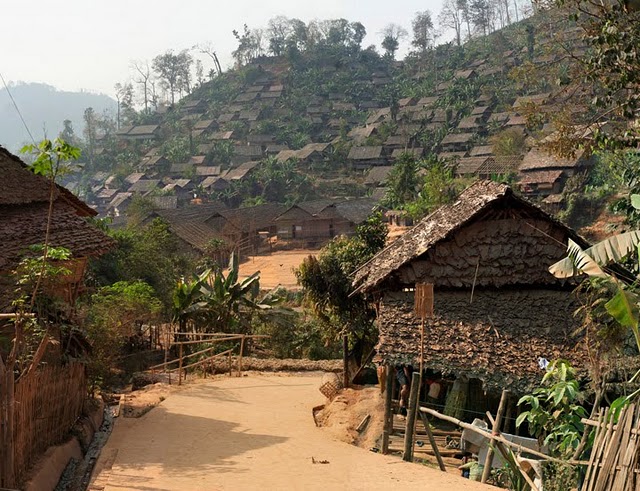
The camp has a very cramped, ramshackle feel. Refugees can't leave this camp for Thailand because it is very remote, and the road has a number of Thai border guard check points along the way. There is no need for a fence. There's no sign anywhere of a UN presence, for example row or prefab housing, signs, offices. Word is the Thai government works hard to keep the UN out, though the UNHCR is the umbrella organization for Mae La Oo.
Motor bikes are illegal here, again permitted “under the table,” so of course they're all over the place. I ask how I'm going to leave the camp, and Hlah Tay explains: “Yes, we will make arrangements. You can go by motorbike.” I ask if I can't hitch a ride with an out-going transport truck. “Oh no, because driver would not dare.” I do leave by motor bike the next day, with an ABSDF driver.
The inhabitants of Mae La Oon are a mixed bag compared to Shan land. There are a few Shan here, like the man building a new house who does push-ups every morning, and practices his English in the hopes it will help his resettlement application. He has been in camp for six months, and wants to go to the US.
Others range from curly-haired East Indian looking people, to square-faced Mongolians, to round-faced, pale people with full red lips.
It's crowded. Dogs, poultry, pigs and people are close together in small, often randomly arranged bamboo structures. Theirs is an accentuated appearance of poverty as they are forbidden from creating permanent concrete structures. There is a narrow paved road through the centre of camp, some of the rest of it has gravel, most is packed dirt. Even the school is a bamboo platform on top of muddy sandbags and dangerously eroded packed earth.
Labels:
ABSDF,
Karen,
Mae La Oo,
refugee,
refugee camp
Ma La; the Biggest Refugee Camp in Thailand
Elvis' father loved The King, so he named his son “Elvis.” He's from a Karen village near Rangoon. The Tatmadaw (Burmese state army) burned his village down in 2008, driving Elvis and his wife into the jungle. They walked through the forests for a month with a group of 55, aiming for the Thai border.
The Karen National Union (KNU) army provided what help they could to get the group to Mae La refugee camp, several miles from Mae Sot and the Friendship Bridge that funnels tourists into Burma. Mae La is the largest refugee camp in Thailand—40,000 people live here. It's also the oldest at 24 years. It's built along the highway so it's not difficult for tourists to see this spectacle. Go, see it.
Some problems are easy to guess – there is never enough food. Water can be tight, housing is very crowded and there's only a rudimentary economy. Of the nearly 2,000 homes in Elvis' section of the camp, 10 have electricity.
The United Nations High Commissioner for Refugees (UNHCR) is the umbrella administrator for the refugee camp, however it's presence is barely palpable. Instead, it is the KNU that involves itself in the daily life of Karen refugees. Elvis explains “they help. If they do not help all refugees then all have no hope. All die I think...Now many people are running in the jungle...so we pray for them.”
With a year's experience teaching in Burma, he was hired on to teach at one of Mae La's many schools (the camp has eight high schools, 18 primaries, three colleges and “many” kindergartens. None of these are sophisticated education centres. Rather, they are bamboo long houses. If they're lucky they have concrete floors and tin roofs, otherwise they have dirt floors and thatched roofs).
The KNU organizes a curriculum close to that in Burma. As in many other Burmese refugee and IDP camps, half of the curriculum is devoted to learning languages. The subjects taught are English, Thai, Karen, Burmese, Math, Science and History. This seems to apply around the entire border, with only the ethno-specific language changing. Despite the difficulties of life in a refugee camp, many Burmese send their children their for education, a type of war zone boarding school where children are relatively safe and the standard of education is slightly better. Many return to Burma for the holidays.
Some problems are easy to guess – there is never enough food. Water can be tight, housing is very crowded and there's only a rudimentary economy. Of the nearly 2,000 homes in Elvis' section of the camp, 10 have electricity.
The reason there isn't enough food is partially due to the fact that the UNHCR office is not permanently open to register refugees. Instead, registration only occurs every four to five years. The Thai border authority (TBBC) registers newcomers immediately, but it's the UNHCR that administers food rations, and it sets a limit on how many will be registered for rations and an ID card that allows them in and out of camp. Elvis says between 13,000 and 14,000 of Mae La's 40,000 residents are registered with the UNHCR. To make up for the shortage the KNU and smaller NGOs bring in extra supplies, and registered residents share what they have. In general, everyone gets two basic meals a day.
To Elvis, the biggest problem is resignation, especially among those growing up in the camp. Some have spent their entire life here. They can't understand life in Burma, Thailand or the magical “third country” on which everyone pins their hopes.
New arrivals know what life is in Burma, so they decide to work as hard as they can to make a new life. Elvis' new students work harder in school, believing if they do it will improve their chances at being accepted into Thailand or for emigration to a third country. Students native to the camp know the third countries, usually the US and Australia, only take a few dozen out of 40,000 every year. They know a life of boredom and free food.
“Some students have a high value of learning,” says Elvis. “Some are not interested because if you're born in camp you get your rations and no working. It's not a lot but... if you're used to eat that much, so, it's OK.” He says he tries to coax them into hope. “Don't prefer your life for your rations. You should try hard.”
The CIA World Factbook states there were 132,000 refugees in Thailand as of 2007. That doesn't count legal and illegal migrants, which are estimated to be two million Burmese in Thailand.
To Elvis, the biggest problem is resignation, especially among those growing up in the camp. Some have spent their entire life here. They can't understand life in Burma, Thailand or the magical “third country” on which everyone pins their hopes.
New arrivals know what life is in Burma, so they decide to work as hard as they can to make a new life. Elvis' new students work harder in school, believing if they do it will improve their chances at being accepted into Thailand or for emigration to a third country. Students native to the camp know the third countries, usually the US and Australia, only take a few dozen out of 40,000 every year. They know a life of boredom and free food.
“Some students have a high value of learning,” says Elvis. “Some are not interested because if you're born in camp you get your rations and no working. It's not a lot but... if you're used to eat that much, so, it's OK.” He says he tries to coax them into hope. “Don't prefer your life for your rations. You should try hard.”
The CIA World Factbook states there were 132,000 refugees in Thailand as of 2007. That doesn't count legal and illegal migrants, which are estimated to be two million Burmese in Thailand.
Subscribe to:
Comments (Atom)